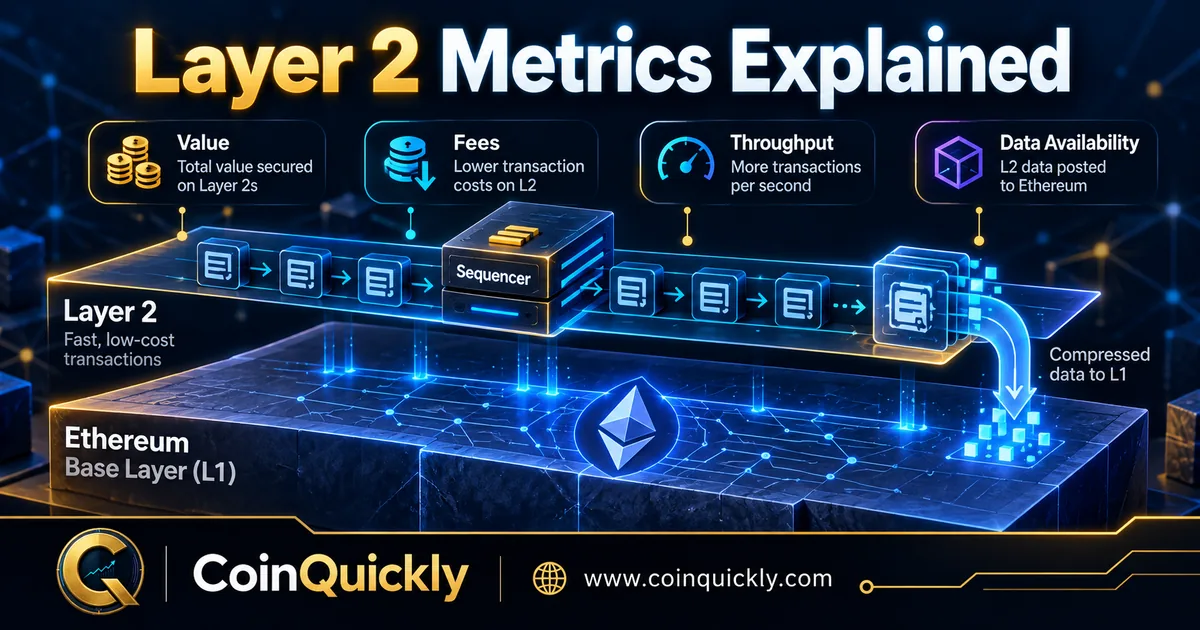
Layer 2 Metrics: TVL, Fees, Throughput & Security
Learn how to read Layer 2 value, fees, throughput, sequencer controls, and data availability together without mistaking activity for security or low fees for sustainability.
10 min readRead article →
 CoinQuickly
Category Archive
Data-driven metrics, exchange volume, and price trends.
Learn how to read Layer 2 value, fees, throughput, sequencer controls, and data availability together without mistaking activity for security or low fees for sustainability.
Learn how to identify crypto market regimes using trend, participation, liquidity, and leverage—without claiming to know the next top or bottom.
Learn how interest rates influence Bitcoin through opportunity cost, financing, the dollar, and risk appetite—and why rate cuts do not guarantee crypto gains.
Learn what Bitcoin ETF inflows and outflows measure, how creations and redemptions work, and why flows differ from trading volume, AUM changes, and price predictions.
Learn how to measure crypto volatility, compare realized and implied volatility, calculate drawdowns, and assess liquidity, leverage, and tail risks beyond daily returns.
Learn how crypto exchange inflows, outflows, and netflows work, why wallet labels and exchange coverage matter, and how to separate transfers from trading signals.
Understand Bitcoin correlation with stocks, gold, the dollar, and interest rates, including return calculations, rolling windows, timing errors, and portfolio limits.
Evaluate blockchain activity using fees, address participation, successful transactions, and validator concentration, with a worked example and a practical verification framework.
Learn what DeFi TVL, fees, revenue, APR, and APY measure, how to reconcile them, and which protocol risks remain invisible on a dashboard.
Understand how crypto prices form through orders, liquidity pools, supply, demand, arbitrage, and leverage—and why market cap is not money flowing in.
Learn how to read active addresses, exchange flows, MVRV, and network activity, check their limitations, and combine them without turning metrics into price predictions.
Learn how to combine funding rates, open interest, price, and liquidation data without mistaking crowded positioning for a directional forecast.