
By CoinQuickly Editorial Team
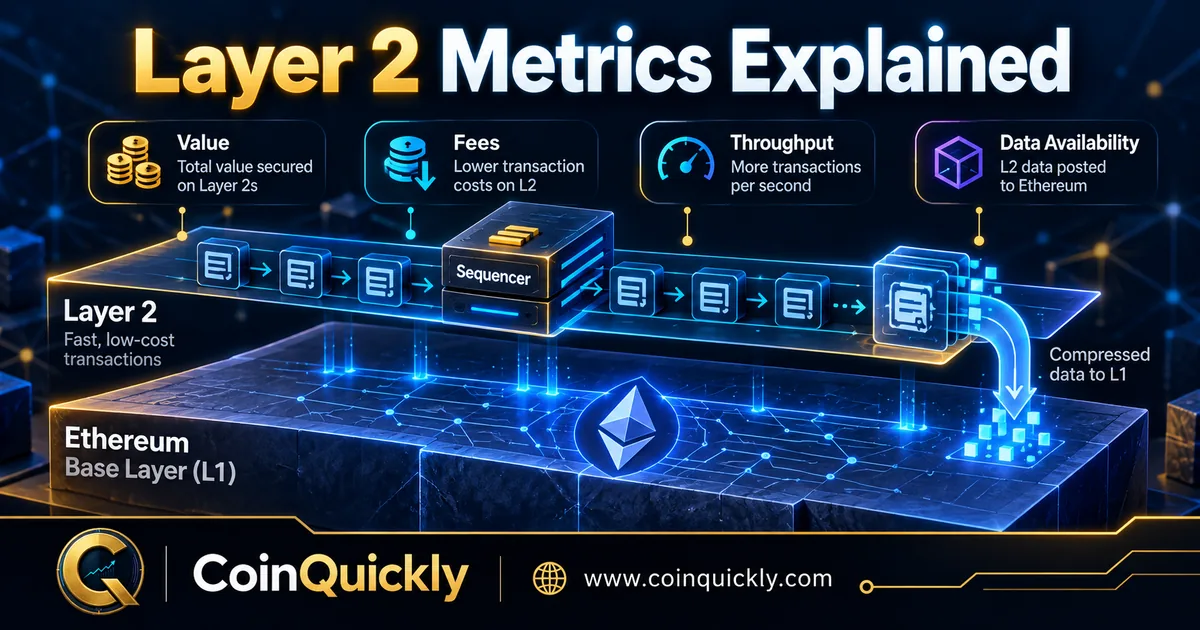
Layer 2 metrics describe different parts of a scaling network. TVL or total value secured estimates assets associated with it; fees show what users pay; throughput measures processed activity; a sequencer controls transaction ordering in many designs; and data availability determines whether the information needed to reconstruct and check the chain can be obtained. None of these numbers alone establishes that an Ethereum Layer 2 is inexpensive, widely used, profitable, or secure. This guide shows how to read them together, compare like definitions and time windows, and inspect the withdrawal and verification paths behind a dashboard.
Key Takeaways - 📊 DeFi TVL and total value secured (TVS) count different asset sets; both can move when token prices change. - Low user fees do not reveal the rollup's net economics until L1 data, proof, and operating costs are considered. - A throughput figure needs a transaction or operation definition and a measurement window. - Sequencer control, state validation, and data availability are separate questions that affect censorship, verification, and exits.
🧭 What do the main Layer 2 metrics measure?
| Metric | Useful question | Important limit |
|---|---|---|
| DeFi TVL | How much value is counted in applications on this chain? | Excludes assets simply held or transferred on the chain; price changes alter USD totals |
| Total value secured (TVS) | How much tracked asset value is secured by the L2's system? | Depends on bridge, native-token, and external-asset definitions; not proof of safety |
| User transaction fee | What did a specified transaction cost at a given time? | Varies by action, congestion, fee design, and quote currency |
| Network fees and operator margin | What did users pay, and what remained after expenses? | Gross fees are not sequencer profit or protocol revenue |
| Throughput | How many defined transactions or operations completed per second? | A burst or synthetic action mix may not represent ordinary use |
| Sequencer and DA status | Who orders transactions, and where can state data be retrieved? | A descriptive risk assessment, not a single numeric performance score |
CoinQuickly's guide to blockchain network activity explains why transaction counts and user counts need consistent definitions. The same discipline applies when an L2 dashboard combines activity with asset values.
💰 Does Layer 2 TVL show how much people use the network?
No. TVL measures value under a provider's accounting rules, not transaction frequency or unique users. DeFi TVL generally counts assets deposited in applications. L2BEAT instead uses total value secured (TVS) for the tracked fungible assets managed by a project, including canonically bridged, externally bridged, and natively minted assets. L2BEAT's own FAQ explicitly distinguishes its TVS from DeFi TVL.
When comparing two dashboards, record the name of the metric and the asset categories included. Check whether bridged representations and underlying assets are counted twice, whether native tokens are included, and whether a quoted USD change came from token prices rather than net deposits. A stable asset balance can produce a rising dollar TVL when its market price rises. The DeFi metrics guide gives a fuller accounting of TVL and its limits; here the extra question is which assets the L2 itself secures.
CoinQuickly analysis — hypothetical example: If a chain holds 1 million units of a token valued at $100 each, its marked value is $100 million. If the quantity stays at 1 million but the token price rises to $150, the marked value becomes $150 million, a 50% increase with no new token deposit. This illustration assumes no other assets or balance changes. It shows why TVL growth should be decomposed into quantity and price before calling it adoption.
🧾 What do Layer 2 fees tell you?
A user fee is the amount charged for a particular L2 transaction. It can reflect L2 execution, a share of L1 data publication, and other chain-specific charges. Ethereum's optimistic-rollup documentation describes L1 data and L2 operator costs as distinct components; blob data has its own fee market. Actual formulas differ by chain and can change through upgrades. Compare the same action, time, quote currency, and fee percentile when assessing affordability.
Network fees are also different from economic margin. A sequencer or operator may collect user fees while paying Ethereum to publish batches and incurring proof-generation, compute, infrastructure, and other costs. Some fees may go to a treasury or be burned, depending on the design. A dashboard's “fees” field may mean user-paid fees, protocol-retained revenue, or a data provider's specific definition; inspect the methodology before dividing it by transactions or calling it profit.
🔍 How to Verify: For a representative transfer and contract interaction, check an actual transaction receipt, the amount charged on L2, and the corresponding L1 batch or blob publication. Then compare the provider's fee definition with the chain's current documentation. One cheap transfer does not establish the cost of every operation.
🚦 Is transactions per second a useful throughput measure?
Yes, if its unit and window are clear. Transactions per second (TPS) is a count of included transactions divided by elapsed seconds. An L2 that includes 864,000 transactions in 24 hours has a 24-hour average of 864,000 ÷ 86,400 = 10 TPS. A peak over one minute, a 24-hour average, and a theoretical benchmark describe different conditions and should not be placed in the same ranking without labels.
Transactions also differ in computational work. A simple transfer and a complex contract call count as one transaction each but consume different resources. Some analytics use user operations per second (UOPS) to reflect batched or account-abstraction actions; its definition is not interchangeable with raw TPS. Check whether a dashboard includes system transactions, failed transactions, L1 deposits, and internal operations. The on-chain data guide explains similar counting problems for addresses and activity signals.
High observed throughput can indicate demand or capacity, but it does not reveal finality, censorship resistance, application quality, or whether usage was subsidized. A meaningful comparison pairs throughput with fees, transaction mix, and the rollup's publication cadence over the same period.
🔀 Why does the sequencer matter?
A sequencer orders L2 transactions and commonly produces fast, preliminary confirmations before batches are posted to Ethereum. A fast sequencer response is therefore not the same as Ethereum settlement or the end of an optimistic rollup's challenge period. A single operator can offer predictable ordering and latency while creating a concentration point for downtime, censorship, and transaction-ordering power.
Ask who can run the sequencer today, not only what a roadmap proposes. If it stops or refuses a transaction, can a user submit through an L1 inbox or other forced-inclusion path? How long can that path take, and can the user exit without the sequencer's cooperation? The answer is project-specific. L2BEAT's risk framework assesses sequencer failure, state validation, data availability, exit windows, and proposer failure separately because an L1 escape mechanism does not automatically solve all five problems.
⚠️ Risk Warning: “Decentralized sequencer” is not a substitute for checking live permissions, upgrade controls, the force-inclusion route, and the independent ability to withdraw. A rollup can process transactions quickly while users still depend on a small set of operators for key functions.
📦 What is data availability, and where is the data stored?
Data availability (DA) asks whether the transaction or state data needed to reconstruct an L2's state can actually be accessed. For optimistic rollups, challengers need that data to check a proposed state and build a fraud proof. For validity-proof systems, a proof can establish a state transition's correctness, but users and independent operators still need sufficient state data to track balances and exercise exits. Proof validity and DA answer different questions.
Ethereum rollups can publish compressed data as calldata or blobs. Calldata is recorded in Ethereum transaction history. Under EIP-4844, Ethereum guarantees that blob data is served for a limited window of roughly 18 days; this is a minimum availability period, not a promise of permanent archival access. Longer-term retrieval depends on others storing the data. Other systems use an external DA layer or committee, which changes the trust assumptions. L2BEAT distinguishes rollups that publish data to Ethereum from validiums and optimiums that rely on external DA.
Check where the full data is published, who can retrieve it, how its commitment is verified, and what happens if the DA source stops serving it. The Ethereum asset page supplies market context for the base asset used in L1 fees; it does not itself describe a rollup's DA guarantees. The Arbitrum asset page similarly supplies token context, not an assessment of Arbitrum's current sequencer or DA configuration.
🧮 How should two Layer 2 dashboards be compared?
CoinQuickly analysis: Use a two-part reconciliation. First, normalize each numeric field: same date and timezone, same USD pricing convention, same transaction definition, and the same 24-hour or 7-day window. Second, write the operational dependencies beside those numbers: proof or challenge mechanism, who can sequence and propose, L1 force-inclusion path, DA location, and withdrawal controls. This keeps a high TVS or TPS from silently standing in for a security conclusion.
For example, if two L2s each show 10 average TPS but one count excludes system transactions while the other includes them, the numbers are not directly comparable. If one reports DeFi TVL and the other TVS, comparing their dollar values as if they measure the same pool is also invalid. If a chain advertises a low median transfer fee, inspect how it pays for L1 data and whether that price persists for complex transactions. These are comparison rules, not live claims about any named chain.
✅ A practical Layer 2 review checklist
- Name the architecture. Identify the project's current proof system, Ethereum settlement contract, and DA arrangement.
- Reconcile value. Separate DeFi TVL, TVS, bridged assets, native assets, quantities, and USD price effects.
- Match fee definitions. Compare the same transaction type and time; distinguish user fees from operator revenue and L1 costs.
- Normalize activity. Use the same TPS or UOPS definition, window, and treatment of system or failed transactions.
- Test the sequencer path. Check current operator permissions, downtime history, forced inclusion, and exit procedure.
- Trace data publication. Confirm whether full data is in Ethereum calldata, blobs, or an external system, and how long independent parties can access it.
- Check change controls. Review upgrade permissions and delays, because risk can change without an obvious move in TVL or TPS.
How CoinQuickly analyzed this
Sources were reviewed November 2, 2026. Ethereum documentation and EIP-4844 establish the roles of calldata, blobs, sequencers, and fraud or validity proofs; L2BEAT supplies its TVS definition and risk dimensions. The article does not rank live L2s or quote current dashboard values. Its two calculations use hypothetical inputs: 1 million tokens at $100 and then $150 with unchanged quantity, and 864,000 transactions over exactly 86,400 seconds. The comparison criteria are definition, unit, observation window, price treatment, and operational dependency. Exclusions include live fee samples, actual chain revenue, token prices, and project-specific security conclusions; those require a dated review of the named chain's contracts, documentation, and on-chain records.
Frequently Asked Questions
Is Layer 2 TVL the same as total value secured?
No. DeFi TVL typically counts assets in applications. Total value secured, as used by L2BEAT, includes tracked canonical, external, and native assets managed by the L2 even when they are not deposited in a DeFi app. Compare the provider's methodology before using either figure.
Does higher TPS mean an L2 is more secure?
No. TPS measures counted activity over time. Security and recoverability also depend on state validation, sequencer permissions, DA, upgrade controls, and exits.
Does a fast sequencer confirmation mean final settlement?
No. A sequencer's preliminary confirmation can precede publication and settlement on Ethereum. Optimistic rollups can also have a challenge period before an L2-to-L1 withdrawal is finalized.
Are Ethereum blobs permanent storage?
No. Ethereum makes blob data available for a protocol-defined period, roughly 18 days under EIP-4844. Archival access beyond that period depends on other storage arrangements.
Can a validity proof replace data availability?
No. A validity proof checks a state transition, while DA concerns access to the underlying information needed to reconstruct state and support independent use or exits. A system with external DA introduces different dependencies from one publishing data to Ethereum.
In short: value and activity show scale, fees show a particular cost, and sequencer and DA design explain critical dependencies. A useful L2 comparison records all of them with matched definitions and a current review of the actual system.
Disclaimer: The content on this website is for informational and educational purposes only and does not constitute financial or investment advice. The cryptocurrency market involves a high level of risk. Always do your own research (DYOR) before making any decision.