Key Takeaways
CryptoSlate reports that certain variable difficulty controllers can keep demanding high work from slowed Bitcoin miners, causing wasted electricity.
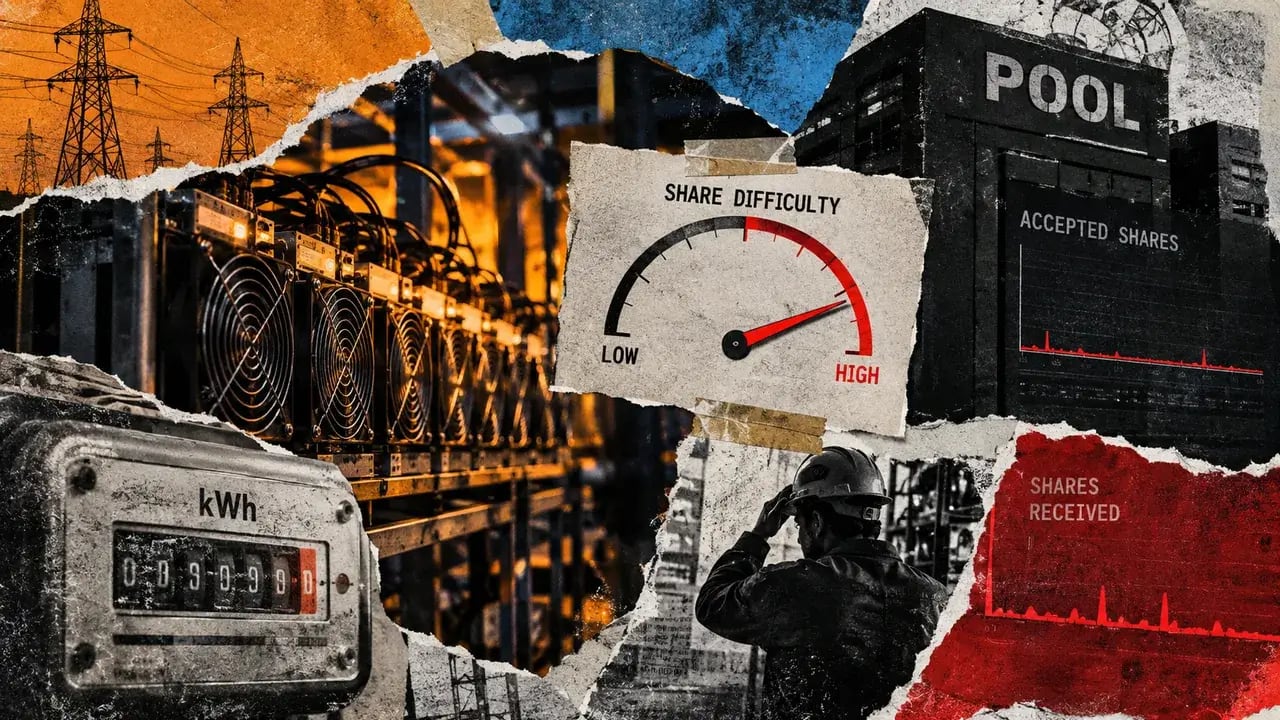
According to CryptoSlate, certain Bitcoin mining variable difficulty controllers can keep demanding work calibrated for a machine's former speed after a power cut. Mining engineer Eric Price and Bitcoin Optech highlighted that if a controller recalculates only upon receiving a share, a sharp slow-down makes the next share less likely. Without a fresh share to trigger an update, the controller can hold the wrong difficulty, leaving slowed machines hashing through a finite window with sparse accepted shares and consuming continuous electricity while receiving little or no pool-side credit.
The analysis concerns pool-assigned share difficulty rather than Bitcoin network difficulty. While high share difficulty does not automatically erase expected long-term credit, a pay-per-share miner receives no payment for intervals with no accepted share. The Stratum V2 reference implementation avoids permanent freezes using a timer, though ckpool was identified as a deployed share-triggered example. MARA Foundation released an open-source shape-proxy allowing operators to test whether a pool lowers difficulty after an apparent decline. Available sources have not measured how common the behavior is or whether it caused material real-world losses.
Source & Fact-Check Note
https://cryptoslate.com/why-cutting-power-to-bitcoin-miners-can-actually-burn-more-energy/