Crypto wallet security is the practice of protecting the keys that authorize transactions, checking what those keys sign, and preserving a workable recovery path. A hot wallet is convenient but keeps a signing environment online. Cold storage keeps the signing key offline, while a seed phrase may restore that key if a device fails. Multisig can require independent signers before funds move. Each control addresses a different failure, and none repairs a backup that is exposed, a transaction approved to an attacker, or a recovery plan that no one can execute.
Key Takeaways
- A wallet manages keys and transaction signatures; the assets remain recorded on a blockchain.
- Cold storage reduces online key exposure, but the user must still verify addresses, network, and transaction details.
- A recovery phrase is usually sufficient to rebuild a compatible wallet; protect it like access to the assets it controls.
- Multisig changes who must approve a transfer, but adds signer, configuration, and recovery complexity.
- Test a new setup with a small transfer and a safe recovery rehearsal before relying on it.
🔑 What does a crypto wallet actually protect?
A wallet protects the secret used to authorize blockchain transactions. Its app or device may display balances and receiving addresses, but coins do not sit inside the phone or hardware device. A private key signs; a public address identifies a destination. If an attacker obtains a key or a compatible recovery phrase, they may be able to authorize transfers without your device.
The first decision is who controls the keys. In self-custody, you or your chosen signers control them and assume backup responsibility. With an exchange or third-party custodian, that provider generally controls the keys and introduces counterparty risk. The SEC's retail custody bulletin distinguishes these models and advises users to examine both operational safeguards and what happens if the provider fails. Our crypto exchange evaluation guide covers that separate custody decision.
Wallet security has three layers: key secrecy (can someone steal the signing material?), signing integrity (could you approve the wrong action?), and recovery availability (can authorized people regain access after loss or failure?). Improving one layer does not automatically improve the other two.
📱 Hot wallets versus cold storage: what changes?
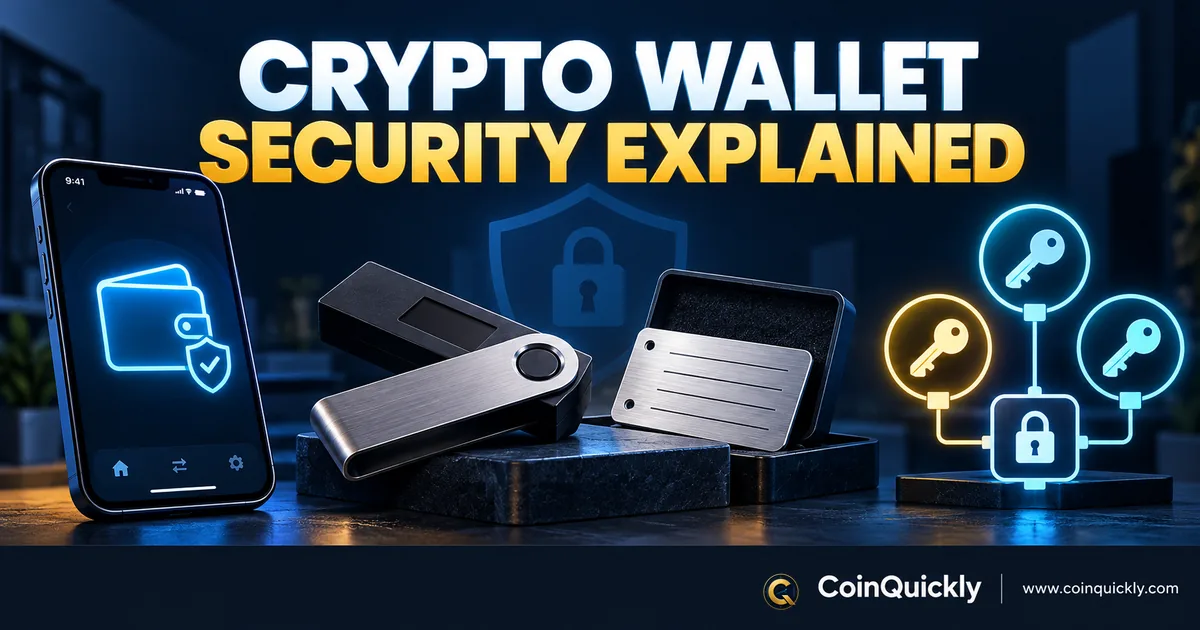
A hot wallet signs from an internet-connected environment; cold storage keeps the private signing key offline. A mobile or browser wallet is usually hot. A hardware wallet commonly keeps the key on a dedicated device and sends only a signature to the connected app. Bitcoin.org describes offline storage and backups as separate safeguards; ethereum.org similarly treats hardware wallets as a way to keep keys away from an internet-connected computer.
| Setup | Signing environment | Main advantage | Remaining failure path |
|---|---|---|---|
| Software hot wallet | Phone or computer connected to the internet | Fast payments and app interaction | Malware, phishing, exposed backups, mistaken signatures |
| Hardware wallet | Key stays on a dedicated device during supported signing | Limits exposure of the private key to the host | Malicious transaction approval, tampered interface, lost backup, device or supply-chain issue |
| Offline or air-gapped signing | Signing system is kept off networks | Further separation from online systems | Transfer and verification mistakes, physical compromise, unusable recovery |
| Third-party custodial account | Provider controls signing keys | Provider handles key operations | Provider outage, compromise, restrictions, or insolvency |
Cold is not the same as risk-free. A hardware device can show a transaction different from a compromised computer's screen, so verify the destination and material terms on the trusted display where supported. Some contract interactions are difficult to interpret on a small screen; if the wallet cannot show what an approval grants, pause rather than treating device confirmation as proof of safety.
Keeping separate wallets for routine activity and longer-term holdings can limit the scope of an exposed hot-wallet key. This is an operational choice, not a required allocation rule. CoinQuickly's broader crypto risk-management framework helps place wallet controls beside platform and counterparty risks.
📝 What is a seed phrase, and how should you back it up?
A seed or recovery phrase is a human-readable way to reconstruct keys in many deterministic wallets. BIP-39 specifies one widely used mnemonic scheme and allows phrases of 12, 15, 18, 21, or 24 words. Wallets can use other recovery designs, so follow the documentation for the exact wallet rather than assuming every phrase is BIP-39 or portable to every app.
Generate the phrase with a trusted wallet setup process. Record words in the correct order, verify them using the wallet's own confirmation flow, and store backups where unauthorized people cannot read them and ordinary damage is less likely to destroy every copy. Do not photograph the phrase, put it in a cloud note, send it to yourself, or type it into a website or support chat. No legitimate recovery assistant needs you to reveal it in a message.
A BIP-39 passphrase is not the same as an app password or device PIN. Under BIP-39, the optional passphrase changes the derived wallet. Forgetting it can make a valid seed phrase recover a different, apparently empty wallet. If used, plan how authorized people can recover both components without placing them together in an exposed location. Avoid adding this complexity unless you can reliably test and document it.
Backups need a recovery test, not just a storage location. Use the wallet's supported recovery-check function or a controlled spare device, away from an untrusted computer. Confirm that the expected account or receiving address appears; never enter a cold-wallet phrase into an ordinary website to test it. For multisig, recovery may also need wallet configuration data in addition to signer backups.
⚠️ Why can a secure device still sign a harmful transaction?
A private key can remain secret while its owner authorizes a bad action. Phishing sites can imitate a wallet or decentralized app. A user may sign a token allowance, contract interaction, or transfer without understanding its effect. Ethereum's security guidance warns about fake sites and requests for recovery phrases; a hardware signer does not decide whether an address or contract is trustworthy.
Before signing, verify the site or app through a known route, the blockchain network, destination, asset, amount, spender, approval limit, and any contract permission. Treat a request for an unlimited token allowance as broader than a one-time transfer. When a wallet shows opaque data or “blind signing,” you may not be able to verify the action from the device alone. Decline the request if the intended effect is unclear.
For a transfer, use a known receiving address and compare its full address on a trusted screen when practical; copied address prefixes and suffixes alone can hide a substitution. Send a small test amount when network fees and product terms make that sensible, then verify receipt before sending more. Use the Bitcoin asset page and Ethereum asset page for asset context, while relying on the wallet and recipient's official instructions to verify the exact network, token contract, and deposit address. Market pages do not validate a recipient address.
For smart-contract wallets and decentralized apps, code risk also matters. An audit addresses a defined code version and scope; it cannot guarantee the safety of a later upgrade, user interface, signer, or transaction. Our smart contract audit guide explains how to read that scope.
👥 What does multisig protect, and what does it add?
Multisignature control requires a specified number of independent approvals before a transaction can execute. A 2-of-3 setup requires any two of three authorized signers. It can reduce reliance on a single key, but the result depends on how independent the signers, devices, people, locations, and recovery paths really are. Safe's documentation describes owners and signature thresholds for its smart-account model; Bitcoin multisig uses a different transaction and wallet architecture.
The threshold creates a tradeoff. A 1-of-3 setup preserves access if two signers are lost but does little to stop one compromised signer. A 3-of-3 setup requires all signers and can become unavailable if any one is lost. A 2-of-3 setup tolerates one unavailable signer and resists one compromised signer under the assumption that the others remain independent and the wallet configuration is sound. Those properties do not address two colluding or compromised signers, a malicious interface, or a vulnerable smart contract.
For teams, define who may propose, review, sign, and replace owners. For individuals, storing all signing devices and backups together weakens the intended separation. Before funding a multisig wallet, test a small deposit, an ordinary transfer, one unavailable signer, and the recovery procedure. Record the wallet address, network, threshold, signer identities or public-key details, and required configuration in a secure recovery plan. Keep secrets protected separately.
CoinQuickly analysis: The useful comparison is a failure-path matrix, not a single security score. Cold storage chiefly reduces online key exposure; multisig chiefly reduces single-signer control; backups chiefly preserve access; transaction review chiefly reduces mistaken authorization. A setup is incomplete if it covers three paths but leaves one obvious path unaddressed.
🧭 Which setup fits the job?
Choose a configuration by the frequency of transactions, the value and type of assets, the number of people who must approve spending, and the ability to maintain backups. The examples below are decision patterns, not recommendations for a particular person or balance.
| Use case | Practical starting pattern | What to test before relying on it |
|---|---|---|
| Frequent small payments or app use | Dedicated hot wallet with limited exposure | Device security, approvals, backup, and a small outgoing transfer |
| Infrequent self-custody | Hardware signing with offline recovery backup | Address verification, supported assets, recovery rehearsal |
| Shared treasury or separated approval | Independently operated multisig signers | Threshold behavior, signer loss, role changes, configuration recovery |
| Custodial convenience | Provider account with clear custody terms and account controls | Legal entity, withdrawal path, recovery, provider failure exposure |
Avoid unnecessary complexity. More devices, passphrases, and signers create more opportunities for configuration and recovery errors. Select controls that address a specific failure path you can explain and test.
✅ Wallet security checklist
- Identify who controls each signing key and how transactions are approved.
- Obtain wallet software or hardware through a verified official channel; follow its setup and firmware guidance.
- Generate and record the recovery material privately; never share it with a website, chat, or unsolicited “support” contact.
- Store backups against both unauthorized access and physical loss; document any passphrase separately with a recoverable plan.
- Confirm the wallet's recovery method and expected address in a controlled test.
- Check the asset, network, destination, amount, and permissions on every material signature.
- Review old token approvals and connected applications when relevant; understand that revoking an approval does not undo prior transfers.
- If using multisig, test the threshold, a missing signer, owner replacement, and restoration of configuration data.
- Keep a written response plan for a lost device, suspected phrase exposure, phishing signature, or inaccessible signer.
How CoinQuickly analyzed this
This guide was prepared on October 30, 2026 using the SEC's retail custody bulletin, Bitcoin.org wallet guidance, the BIP-39 specification, ethereum.org wallet and security documentation, and Safe's owner-and-threshold documentation. CoinQuickly grouped controls by four failure paths: key theft, unintended signing, inability to recover, and third-party failure. The comparison is qualitative; no wallet, device, vendor, or multisig deployment was tested or ranked. Wallet implementations, supported networks, recovery methods, and contract behavior differ, so check the documentation for the exact product and version before acting.
Frequently asked questions
Does a hardware wallet make crypto impossible to steal?
No. Keeping a private key on dedicated hardware limits one attack path, but a stolen recovery phrase, malicious approval, tampered setup, or incorrect transfer can still cause loss.
Can I recover a wallet if the hardware device breaks?
Often, if you retained the correct recovery material and a compatible restoration method. Verify the exact wallet's requirements in advance; an optional passphrase or multisig configuration may also be necessary.
Is a seed phrase the same as a password?
No. A seed phrase can reconstruct signing keys in many wallets. An app password or PIN usually protects local access to a device or app, though specific designs vary.
Is multisig always safer than a single hardware wallet?
No. Multisig can reduce single-key control when signers are independent, but poor setup, shared backups, contract risk, or lost configuration can offset the benefit.
Should I type my phrase into a site that says it can check my wallet?
No. Treat such requests as a serious phishing warning. Use only your wallet's documented recovery or check process in a controlled environment.
The bottom line
Protect the key, the decision to sign, and the path to recover. A hot wallet, hardware signer, seed backup, and multisig threshold solve different problems; choose the combination you can verify, operate, and restore without exposing the secrets that make it work.
Disclaimer: The content on this website is for informational and educational purposes only and does not constitute financial or investment advice. The cryptocurrency market involves a high level of risk. Always do your own research (DYOR) before making any decision.