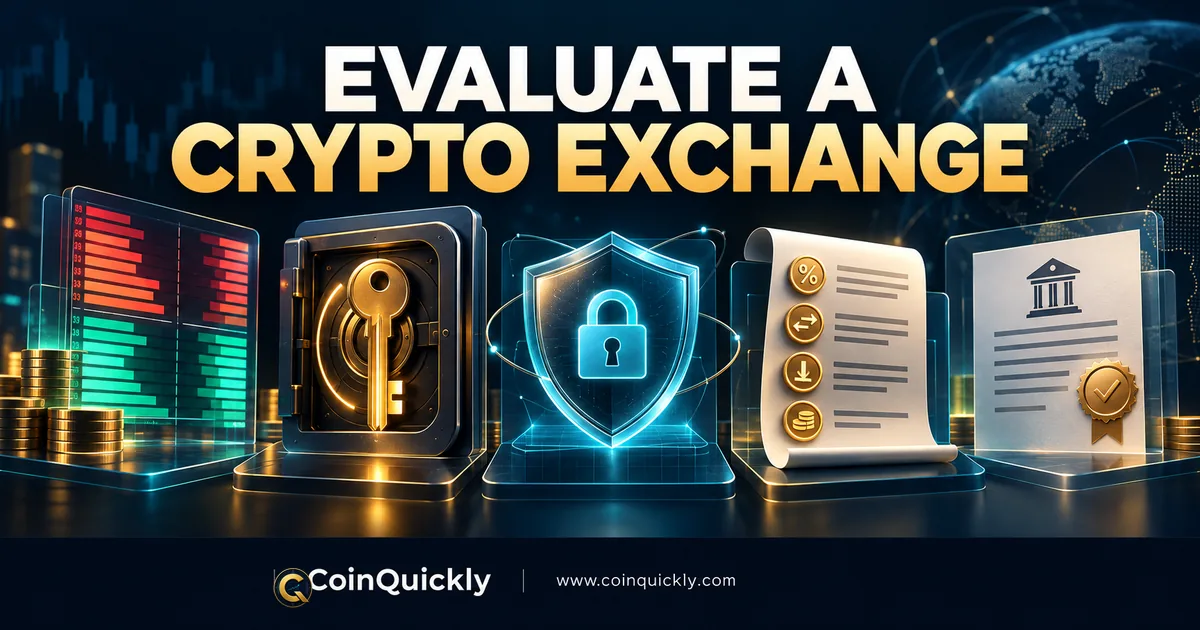
A crypto exchange should be evaluated as both a trading venue and a custodian. A low advertised fee means little if the order book is thin, withdrawals are unreliable, customer assets are poorly protected, or the legal entity serving you is unclear. Start with five checks: liquidity for the asset and order size you actually plan to trade; custody and customer-asset rights; account and platform security; total costs; and regulatory status in your jurisdiction. No single badge, volume figure, audit, or license resolves all five.
Key Takeaways
- Compare executable prices and order-book depth for the exact trading pair and order size, not just headline volume.
- Read custody terms to identify who holds the keys, whether assets are segregated, and what happens if the provider fails.
- Treat proof of reserves, security claims, and regulatory registration as evidence with defined scope, not guarantees.
- Calculate fees, spread, slippage, funding, and withdrawal costs together.
- Verify the exact operating entity and permitted service in an official regulator record.
📊 1. Can the exchange execute your trade at a reasonable price?
Liquidity is the ability to buy or sell an amount without moving the execution price sharply. Inspect the exact pair, such as BTC/USD rather than a platform-wide volume total. The order book shows available bids and asks at different prices; the spread is the gap between the best bid and ask, and depth is the quantity available beyond those quotes.
A displayed last trade is not an offer to fill your whole order at that price. Market orders can consume several price levels, creating slippage. Order-book depth can also disappear before execution. Compare the spread and estimated fill for a realistic order size at several times of day, including less active periods. The CoinQuickly guide to crypto liquidity explains how volume, spread, depth, and slippage differ.
Use CoinQuickly Markets to identify an asset and its wider market context, then inspect the exchange's live pair-specific book for execution. A market-wide volume estimate cannot establish depth on one venue. The Bitcoin market page can provide asset-level context for a BTC example; compare it with the venue's actual BTC pair and quote currency.
How to verify: Record the pair, quote currency, time, spread, depth within a stated price band, and estimated average fill for your order size. Repeat. A single screenshot is a snapshot, not evidence of stable liquidity.
🔐 2. Who controls customer assets and what are your legal rights?
Custody determines who controls the private keys and how a customer may recover assets after a failure. A centralized exchange commonly controls the keys for assets held on-platform. The U.S. Securities and Exchange Commission's retail custody bulletin advises customers to ask how assets are stored, whether a third party is involved, whether assets are commingled or reused, and what happens if the custodian fails.
Read the terms for the precise product and legal entity. Check whether customer assets are held separately from corporate assets, whether the provider can lend or pledge them, and whether withdrawals can be suspended. Identify the entity that owes you the asset, the governing law, and any insolvency language. A wallet address or balance screen alone cannot answer these legal questions.
Proof of reserves may show that specified wallets held specified assets at a point in time. It may omit liabilities, borrowed assets, off-chain accounts, encumbrances, and assets outside its stated scope. The SEC warns that proof-of-reserves exercises should not be equated with a financial-statement audit or proof that customer assets will be available on demand. Our proof-of-reserves explainer details the checks and blind spots.
🛡️ 3. Which security controls can you actually verify?
Security requires evidence about both your account and the exchange's operations. Look for phishing-resistant multifactor authentication where available, withdrawal address allowlisting, login and withdrawal alerts, device/session review, and clear recovery procedures. Test whether a security-setting change triggers an appropriate delay or independent confirmation before withdrawals.
For platform controls, read current security disclosures and incident reports. Ask how keys are controlled, how much exposure remains in online wallets, whether external service providers are involved, how vulnerabilities are reported, and how customers are notified during an incident. A claim of “cold storage” does not describe key governance, insider access, recovery, or the assets left online. An audit or certification covers only its stated scope and date.
Separate three failure paths: account takeover (your credentials or device), platform compromise (the exchange's systems or keys), and counterparty failure (the business cannot meet obligations). Each requires different evidence and controls. The CoinQuickly risk-management framework helps map these dependencies without treating a single security feature as complete protection.
💳 4. What is the total cost of using the exchange?
The relevant cost is the amount you give up from funding through withdrawal, not just the posted trading commission. Review the fee schedule for the exact interface, pair, account tier, order type, payment rail, and network. An instant-buy quote may include a spread or different pricing from an order-book trade. Maker and taker rates can differ; a limit order is not automatically a maker order if it executes immediately.
| Cost layer | What to inspect | Where it appears |
|---|---|---|
| Funding | Bank, card, currency-conversion, or deposit charge | Before trading |
| Trading fee | Maker/taker tier and applicable pair | On each execution |
| Spread and slippage | Difference between reference price and actual average fill | In the quote or fills |
| Holding or financing | Borrowing, margin, or product-specific charge, if used | While position is open |
| Exit | Trading fee, fiat cash-out, network, and withdrawal charge | When leaving |
CoinQuickly analysis — hypothetical example: Suppose an investor converts $1,000 into crypto. A 0.40% trading fee costs $4; a 0.30% unfavorable execution versus the reference price costs about $3; and withdrawal costs $5. The illustrative entry-and-withdrawal cost is about $12, or 1.2% of the starting amount, before any later sale, price move, taxes, or additional network charges. The calculation is $4 + $3 + $5 = $12; it is an approximation because fee bases and execution prices can differ. Repeat the calculation with the exchange's current quoted amounts rather than relying on the example rates.
⚖️ 5. Is the exact entity authorized for this service where you live?
Regulatory status is specific to an entity, activity, jurisdiction, and date. Find the legal name in the customer agreement, then compare it with an official register. Check the services covered, status, restrictions, and any warning or enforcement notice. A brand may operate through several entities; a registration for one service or country does not automatically cover every product or customer.
In the European Union, the Markets in Crypto-Assets framework distinguishes authorized crypto-asset service providers and certain other financial entities permitted to provide covered services. ESMA publishes a register; national competent authorities also hold relevant records. In the United Kingdom, check the Financial Conduct Authority's register and the scope of the firm's status. U.S. requirements depend on the asset, activity, federal and state law, and the entity. Do not infer a universal license from a general compliance claim.
Regulation does not eliminate market, operational, custody, or insolvency risk. U.S. FDIC deposit insurance does not insure crypto assets or protect against a nonbank crypto exchange's failure. If an exchange mentions insurance, read exactly which assets, custodian, loss events, limits, exclusions, and beneficiaries the policy covers.
🔎 Compare evidence, not marketing labels
CoinQuickly analysis: Use the same five questions for every exchange and mark each answer as verified, claimed, unclear, or adverse. Do not add these marks into an arbitrary numerical “safety score”: one unresolved asset-rights issue can matter more than several convenience features.
| Question | Stronger evidence | Incomplete evidence or warning sign |
|---|---|---|
| Can my order execute? | Repeated pair-specific spread and depth checks for a stated size | Only platform-wide volume or a single last price |
| Can I recover assets? | Clear terms on custody, segregation, reuse, and withdrawal | Vague ownership terms or withdrawal discretion |
| Can I protect access? | Usable multifactor controls, allowlisting, alerts, and incident disclosures | Security slogan without scope or response process |
| What will it cost? | Current full quote and fee schedule for funding, trading, and exit | “Low fees” excluding spread or cash-out |
| Who oversees the service? | Exact entity and activity matched to an official record | Brand-level license claim or unrelated registration |
If a key answer remains unclear, document the gap. A small test deposit and withdrawal can reveal operational friction, but one successful test does not prove future access or solvency. Never send a large transfer merely to test a platform.
✅ A practical pre-account checklist
- Identify the legal entity, country, and product in the terms.
- Confirm the exact asset, trading pair, funding rail, and withdrawal network you need.
- Measure spread, depth, and estimated execution for a realistic order size at more than one time.
- Read custody, asset reuse, segregation, insolvency, and withdrawal provisions.
- Check the scope and date of reserve reports, audits, and incident disclosures.
- Review account controls and recovery options before depositing.
- Calculate the full funding-to-exit cost using current quotes.
- Check the relevant official regulator record and its permitted activities.
- Record unanswered questions and reassess when terms, fees, products, or status change.
How CoinQuickly analyzed this
This educational framework was assembled on October 30, 2026 from SEC retail custody and investor-alert materials, FDIC deposit-insurance guidance, ESMA's MiCA register and rulebook, the FCA Financial Services Register, and exchange trading-rule documentation. The five layers correspond to distinct ways an exchange can fail to meet a customer's needs: poor execution, asset-control uncertainty, security failure, unexpected cost, and legal-status mismatch. The cost example is hypothetical and uses stated arithmetic, not observed exchange fees. No exchange was scored or tested, and laws, product availability, fee schedules, order books, and terms can change. Recheck primary records for the entity and transaction at issue.
Frequently asked questions
Is high trading volume enough to show an exchange is liquid?
No. Volume describes reported trading over a period, while your execution depends on the current order book for a specific pair and size. Compare spread, depth, estimated fill, and repeatability.
Does proof of reserves prove that an exchange is solvent?
No. A reserve report may cover selected assets at one point in time and may not establish all customer liabilities, debts, encumbrances, or continued withdrawal access. Read its scope and assurance level.
Does a regulated exchange guarantee my crypto is insured?
No. Verify the exact entity, service, and insurance terms. FDIC insurance does not cover crypto assets or losses caused by failure of a nonbank exchange.
Is a maker/taker fee the full trading cost?
No. Include spread, slippage, funding and conversion charges, withdrawal fees, and any financing charges for the product used.
Is leaving assets on an exchange the same as using a personal wallet?
No. On an exchange, the provider usually controls the private keys for on-platform assets. With self-custody, you control the keys and assume the associated backup and security responsibilities.
The bottom line
Evaluate the exchange you would actually use: its exact legal entity, asset, pair, product, order size, and jurisdiction. Keep the evidence for each of the five checks separate, investigate unresolved rights or withdrawal questions, and update the review as conditions change.
Disclaimer: The content on this website is for informational and educational purposes only and does not constitute financial or investment advice. The cryptocurrency market involves a high level of risk. Always do your own research (DYOR) before making any decision.