Key Takeaways
CryptoSlate reports on Ethereum's candidate Glamsterdam schedule, featuring EIP-8037 and EIP-8038, which targets threefold throughput by sharply increasing gas costs.
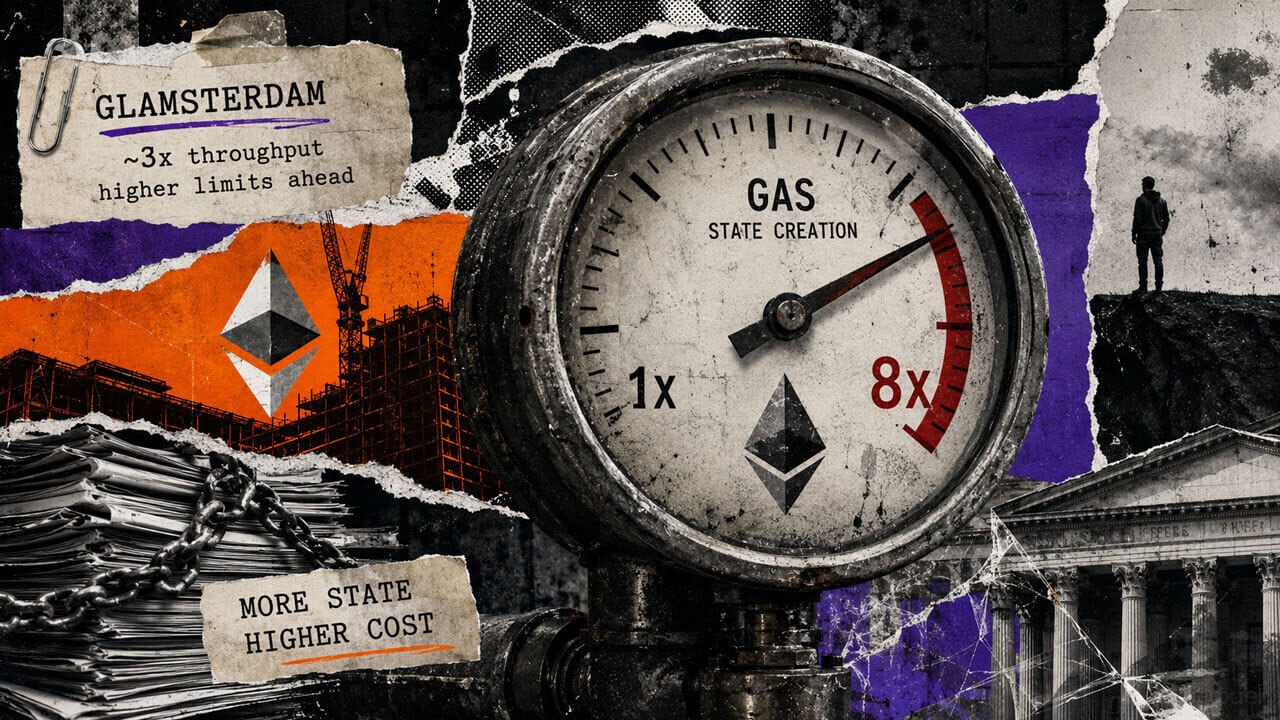
According to CryptoSlate, Ethereum's candidate Glamsterdam schedule aims to triple network throughput by significantly increasing gas costs for creating accounts, storage, and contract code. The upgrade features two proposals, EIP-8037 and EIP-8038, which currently remain under review while slated for Ethereum's 2026 roadmap.
Research analyzing millions of transaction replays under the proposed candidate schedules revealed two distinct groups of failures. A larger cohort of replay failures can be fixed by applying higher gas limits, shifting work to infrastructure providers, frontends, and bundlers. However, a smaller counterfactual cohort exposes brittle contract and gas assumptions, such as fixed 2,300-gas stipends, hardcoded gas forwarded to internal calls, and logic branching on gasleft(). These harder cases may require code changes, routing adjustments, or user migration, particularly for immutable contracts.
Public outreach reports identified potential impacts on smart-account stacks like ERC-4337 EntryPoint versions, ZeroDev, Alchemy, Across, Socket/Bungee, CoW Protocol, and 0x. Wallets, RPC providers, indexers, node tooling, and gas estimators must update their rules before deployment, as tools built around hardcoded gas limits or single gas dimensions face disruption. The proposals leave builders a testing window to revise tooling or migrate contracts before final deployment dates are set.
Source & Fact-Check Note
This report is synthesized from coverage by CryptoSlate. Information has been fact-checked and structured for market clarity by CoinQuickly’s research desk.
Read original article at CryptoSlate ↗